The Audi Quattro is a road and rally car, produced by the German automobile manufacturer Audi, part of the Volkswagen Group. It was the first four-wheel drive grand tourer (GT) since the Jensen FF of 1966.[citation needed] It was first shown at the 1980 Geneva Motor Show on 3 March.[1][2]
The word quattro is derived from the Italian word - four.
The Audi Quattro is considered one of the most significant rally cars, and was the first to take advantage of the then-recently changed rules which allowed the use of four-wheel-drive in competition racing. Many critics doubted the viability of four-wheel drive racers, thinking them to be too heavy and complex, yet the Quattro was an instant success, winning a rally on its first outing.[clarification needed] It won competition after competition for the next two years.[1] To commemorate the success of the original vehicle, all subsequent Audis with their trademark quattro four wheel drive system were badged "quattro" with a lower case "q". The original car with the upper case "Q" in the Quattro name is highly sought after as a collector's piece.
The Audi Quattro shared many components and the core of its body style with the Audi Coupé, which was a member of the Audi 80 (B2) model range.[1] Its characteristic flared wheelarches were styled by Martin Smith.
Similar market competitors of its day included the rear wheel drive BMW E30 M3, four wheel drive Lancia Delta Integrale and Toyota Celica GT-Four, and Ford's Sierra RS Cosworth which was sold as both rear and four wheel drive.
Officially, the model name of the car was simply "Quattro".
The word "quattro" is used to refer to either the Audi 4WD system, or any 4WD version of an Audi automobile. To avoid confusion, this car is also commonly referred to as the Ur-Quattro (the "Ur-" prefix is a German augmentative used, in this case, to mean "original" and is also applied to the first generation, straight five cylinder engined Audi S4 and Audi S6, as in "Ur-S4" and "Ur-S6").
European distribution
Audi released the original Quattro to European customers in late 1980,[1] making it both the first car to feature Audi's quattro permanent four-wheel drive system (hence its name), and the first to mate four wheel drive with a turbocharged engine.[1]
The original engine was an intercooled turbocharged 2,144 cc (131 cu in) (2.1 L), inline-5 cylinder 10 valve SOHC, producing 147 kW (200 PS; 197 bhp) and torque of 285 N·m (210 ft·lbf) at 3500 rpm; propelling the Quattro from 0-100 km/h (62 mph) in 7.1s, and reaching a top speed of over 220 km/h (137 mph).[1]
The engine was eventually modified to a 2,226 cc (136 cu in) (2.2 L) inline-5 10 valve, still producing147 kW (200 PS; 197 bhp), but with peak torque lower in the rev-range.[1] In 1987, it was then changed to a 2,226 cc (136 cu in) inline-5 20v (2.2 L 20v) DOHC setup producing 162 kW (220 PS; 217 bhp), now with a top speed of 230 km/h (143 mph).[1]
Audi Quattros are often referred to among owners and enthusiasts by their engine codes, to differentiate between the earlier and later versions: the earliest 2144 cc 10v being the WR engine, the 2226 cc 10v being the MB engine, and the later 20v being the RR engine. Hence, Quattro models may be referred to as either the WR Quattro, MB Quattro, and RR or "20v" Quattro, respectively.
Quattro car production was 11,452 vehicles over the period 1980–1991,[1][2] and through this 11 year production span, there were no major changes in the visual design of the vehicle. For the 1983 model year, the dash was switched from an analogue instrument cluster, to a green digital liquid crystal display (LCD) electronic instrument cluster. This was later changed in 1988 to an orange LCD electronic instrument cluster. The interior was redesigned in 1984, and featured a whole new dash layout, new steering wheel design, and new centre console design, the switches around the instrument panel were also redesigned at this time. In 1985 the dash changed slightly with harder foam and lost a diagonal stripe, the dash switches changed a bit as well and the diff lock knob gave way to a turning knob with volt and oil temp digital readouts.
External styling received very little modification during its production run. Originally, the car had a flat fronted grille featuring four separate headlamp lenses, one for each of the low and high beam units. This was altered for the 1983 model year, and replaced with combined units featuring a single lens, but housing twin reflectors. This was changed again, for the 1985 model year, in what has become known as the 'facelift model' and included such alterations as a new sloping front grille, headlights, and trim and badging changes. The RR 20v Quattro also featured a new three spoke steering wheel design, leather covering for door arm rests, gloveboxes, centre console and door pockets. There was also a full length leather wrapped center console running all the way to the rear seats. 20v was also the first Ur-q to have "quattro" script interior with partial leather seats. The floor on the drivers side had a bulge due to dual catalytic exhaust setup. The different models may be distinguished by the emblems on their boot lids: the WR had a vinyl 'quattro' decal or a brushed aluminium effect plastic emblem, the MB had chrome plated 'audi', 'audi rings' and 'quattro' emblems, whilst the RR had only chrome plated 'audi rings'.
For 1987, the Torsen centre differential was used for the first time, replacing the manual diff lock.[1]
[edit] North American distribution
Sales of the Quattro in North America began with the 1983 model year, which were constructed concurrently, and were of the same design as, the European 1982 models (they did not include the minor cosmetic changes of the European 1983 model) and continued through 1986. Total sales in the USA were 664. Canadian market received cars that were identical to the US cars with exception of the speedometer, which was metric like the early Euro cars. Official sales figures for Canada were 99, which included 61 in 1983, 17 in 1984, 18 in 1985 and 3 in 1986. Although it's believed that there might have been up to 6 cars bought in 1986.
US/Canadian cars were also equipped with larger impact bumpers with built in shock absorbers, just like the rest of the 4000/Coupé models. None of the cars came with Anti-lock Braking System (ABS), however they were otherwise "loaded" with options, including air conditioning, and in 90% of the cars, leather upholstery. Most of the 1984 and 1985 Canadian models did not have sunroofs. The remainder of the electric, suspension and cosmetic updates took place at the same time as the European cars. Out of 99 cars imported to Canada 35 are still known to be on the road.
The initial 2.1L (2144cc, engine code "WX") engine for US/Canadian models included minor component and engine control unit (ECU) changes, including lowered turbocharger boost pressure, different camshaft, emission controls including catalytic converter, and lambda stoichiometric fuel control, which lowered power to 160 hp (119 kW; 162 PS). Otherwise, mechanical specifications were identical to the European spec cars. The WX engine was also used on Swiss and Japanese market cars. In fact Audi built 200 special edition cars in 1988 with WX engine and analogue instruments, the rest of the car was identical to the MB cars of that year.
Rally cars
Quattro - A1 and A2 evolutions
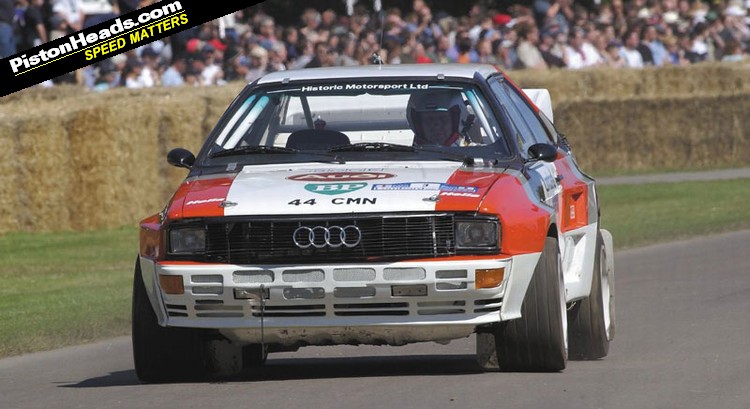
The original Audi Quattro competition car debuted in 1980, first as a development car, and then on a formal basis in the 1980 Janner Rally in Austria. Largely based on the bodyshell of the road-going Quattro models (in contrast to the forthcoming Group B cars), the engine of the original competition version produced approximately 300 bhp (224 kW; 304 PS). In 1981, Michèle Mouton became the first female ever to win a world championship rally, piloting an Audi Quattro.[1] Over the next three years, Audi would introduce the A1 and A2 evolutions of the Quattro in response to the new Group B rules, raising power from the turbocharged inline 5-cylinder engine to around 350 bhp (261 kW; 355 PS).
The Quattro A1 debuted at the 1983 season opener Monte Carlo Rally, and went on to win the Swedish Rally and the Rally Portugal in the hands of Hannu Mikkola. Driven by Stig Blomqvist, Mikkola and Walter Röhrl, the A2 evolution won a total of eight world rallies; three in 1983 and five in 1984.
Sport Quattro
The Audi Sport Quattro was a Quattro programme car developed for homologation for Group B rallying in 1984, and sold as a production car in limited numbers.[1] It featured an all aluminium alloy 2,133 cc (130.2 cu in) (2.1 L) 20v DOHC engine slightly smaller than that of the Audi Quattro (in order to qualify for the 3-litre engine class after the scale factor applied to turbo engines). In road-going form the engine was capable of producing 225 kW (306 PS; 302 bhp),[1] with the competition cars initially producing around 331 kW (450 PS; 444 bhp).[1]
The vehicle also featured a body shell composed of carbon-kevlar[1] and boasting wider arches, wider wheels (nine inches as compared to the Ur-Quattro's optional eight inch (203 mm) wide wheel rim), the steeper windscreen rake of the Audi 80 (requested by the Audi Sport rally team drivers to reduce internal reflections from the dashboard for improved visibility) and, most noticeably, a 320 mm (12.6 in) shorter wheelbase. This was carried out in order to improve handling potential in the face of newer, smaller competition, such as the Lancia 037 and the Peugeot 205 T16, which had been purpose-built from the start for Group B rules.
A total of 224 cars of this "short version" Sport Quattro were built, and were offered for sale at a heady price of 203,850 German Marks.[1]
[edit] Sport Quattro S1
The Audi Sport Quattro S1 was introduced at the end of 1984 as an update to the Audi Sport Quattro. The car featured a inline 5-cylinder engine that displaced 2,110 cc (128.8 cu in) and produced an officially quoted figure of 350 kW (480 PS; 470 bhp).[1] However, the turbocharger utilised a recirculating air system, with the aim of keeping the turbo spinning at high rpm, when the driver closed the throttle, either to back off during cornering, or on gearshifts. This allowed the engine to resume full power immediately after the resumption of full throttle, reducing turbo lag. The actual power figure was in excess of 500 bhp (373 kW; 507 PS) at 8000 rpm.[1]
In addition to the improved power output, an aggressive aerodynamic kit was added that featured very distinctive wings and spoilers to the front and rear of the car to increase downforce. The weight was lightened to just 1,090 kg (2,403 lb), and now accelerate from 0-100 km/h (62 mph) in just 3.1 seconds.[1] Some of the cars were supplied with a "power-shift gearbox", which is said to be a forerunner of today's Direct-Shift Gearbox (DSG) technology.[1]
The S1 proved to be an immediate success in the rally circuit, helping Walter Röhrl[1] and Christian Geistdörfer win the 1985 San Remo Rally. A modified version of the S1, was also driven by Michèle Mouton.[1] The S1 evolution would become the final Group B car produced by Audi, with the works team withdrawing from the Championship following the 1986 rally in Portugal.[1]
Twenty years after the cancellation of Group B, the Sport Quattro S1 was still widely regarded as the most powerful rally car ever fielded in international competition, with the final factory machines of 1986 rated at an incredible 441 kW (600 PS; 591 bhp).[1] In addition to Group B competition, the S1 won the 1985 Pikes Peak International Hill Climb with Michèle Mouton in the driving seat, setting a world record time in the process. This victory was repeated in 1987, this time at the hands of Walter Röhrl.
Other information The Quattro is famous for being a career highlight of one of the pre-eminent women in rally racing, Michèle Mouton.[1]
In 2004, Sports Car International named this car number four on the list of Top Sports Cars of the 1980s.
A Sport Quattro S1 appears in the Colin McRae Rally 04 and Colin McRae Rally 2005, and also in the PC game Rally Masters by EA Digital Illusions CE.
A Mars Red Audi Quattro appears on the 2008 BBC spin-off series to Life on Mars - Ashes to Ashes, and is epitomised by DCI Gene Hunt's order - "Fire up the Quattro".[5]
An Audi Quattro rally car appears in the Xbox game Rallisport Challenge 2.
A Sport Quattro appears in Forza Motorsport 2 as downloadable content.
A Quattro road car appears in Gran Turismo 4.
A Sport Quattro appears in Stunts.
Audi Quattro
Manufacturer Audi AG
Parent company Volkswagen Audi Group
Also called Quattro, Ur-Quattro
Production 1980–1991
Assembly Ingolstadt (N2 assembly line), Germany
Successor Audi S2
Class Coupé, rally car
Body style(s) 2-door coupé
Layout Front engine,
quattro permanent
four-wheel drive
Platform Volkswagen B2 platform
Engine(s) 2144 cc I5 SOHC 10v (1980–87)
2226 cc I5 SOHC 10v (1987–89)
2226 cc I5 DOHC 20v (1989–91)
Transmission(s) 5-speed manual
Wheelbase 2,524 mm (99.4 in)
Length 4,404 mm (173.4 in)
Width 1,722 mm (67.8 in)
Height 1,346 mm (53.0 in)
Curb weight 1,290 kg (2,844 lb) to 1,350 kg (2,976 lb)
Fuel capacity 94 L (20.7 imp gal; 24.8 US gal)
Related Audi 80 (B2),
Audi Coupé,
Audi Coupé GT,
Audi Coupé quattro
Designer Jörg Bensinger,
Walter Treser,
Dr. Ferdinand Piëch,
Franz Tengler (transmission),
Martin Smith (stylist)
From Wikipedia, the free encyclopedia




 100% pure breed.!!!!!